

A word from Greg — I’ve been in your boots.
I owned and ran a trade business for seven years, so when I talk about the challenges of running one, I’m speaking from experience.
I’ve dealt with the customers, the paperwork, the scheduling, the cash flow and all those things that seem to come with owning a business.
And I’ve learned a few lessons along the way. Some of them the hard way.
That’s a big part of why I started Admins The Answer.
Have you ever felt like you’re constantly chasing your tail?
When I think back to running my own trade business, one of the biggest challenges wasn’t necessarily finding customers or getting work.
It was that constant feeling that I was never quite in front.
Always chasing my tail. Always reacting to the next problem. And, if I’m being fair about it, feeling somewhat out of control.
The funny thing is, at first I thought everything was going reasonably well.
After all, I had a full calendar and more than a dollar in the bank.
What more could you want?
Well, as it turns out, quite a bit.
Because having plenty of work doesn’t necessarily mean you’ve got a healthy business.
And having money in the bank today doesn’t mean you’ll have enough to pay tomorrow’s bills.
I learned that one the hard way.
The hamster wheel that never seems to stop
Here’s how things would sometimes go.
You’d get the BAS bill from your accountant and realise you hadn’t put enough money aside to pay it.
Then a supplier would ring wanting payment on your account. And if you didn’t pay something soon, your credit was going to be stopped.
That’s not a particularly pleasant conversation.
Especially when you’ve got another job starting and need to buy materials to get it underway.
Meanwhile, the phone’s still ringing, customers still want their jobs done, and you’ve still got a business to run.
So you work harder, try to get more jobs finished, get some invoices out and hopefully bring enough money in to get through the next round of bills.
And then it happens again.
It’s a bit like being on a hamster wheel.
You’re running flat out, but you’re not actually getting anywhere.
The really frustrating part for me was that I knew something wasn’t right, but I didn’t properly understand what was causing it or how to fix it.
And that’s the danger.
If you don’t understand what’s happening, the hamster wheel can keep spinning for years.
Three words that changed how I looked at my business
I want to tell you about a conversation I had with a family friend.
He was also a customer of mine and a very successful business owner in his own right.
I was at his house one day and decided to ask him a question.
Would he be interested in being my business coach?
His answer was immediate.
“No.”
Well, I’ll tell you, I took that pretty hard at the time.
But he hadn’t finished speaking.
He went on to explain that there was really only one important thing he’d tell me anyway.
“Know your numbers.”
Three words.
That was his advice.
Now, I’d love to tell you that I immediately understood exactly what he meant and went home knowing how to turn my business around.
But I didn’t.
I wasn’t entirely sure what he meant.
I’d always enjoyed maths at school, though, and I certainly wasn’t frightened of sitting down in front of a spreadsheet.
So that’s what I started doing.
I began looking more closely at my business numbers, trying to understand what they were telling me.
There was plenty of self-teaching involved, and I certainly didn’t have all the answers straight away.
But looking back, I can say that’s where the turnaround started.
Not because I suddenly found more customers or worked longer hours.
Because I began to understand what was actually happening in my business.
And once you understand something, you’ve got a much better chance of doing something about it.
And here’s something I’ve come to appreciate about numbers.
The cool thing about numbers is that they don’t lie.
They might tell you something you don’t particularly want to hear, but at least they’re telling you what’s actually happening — provided you’ve recorded the information properly.
You can convince yourself things are going well because the calendar’s full and there’s money in the bank.
But when you start looking at the right numbers, you get a much clearer picture.
And once you’ve got that picture, you can start making better decisions.
So don’t be afraid of the numbers. They’re not there to frighten you. They’re there to help you understand your business.
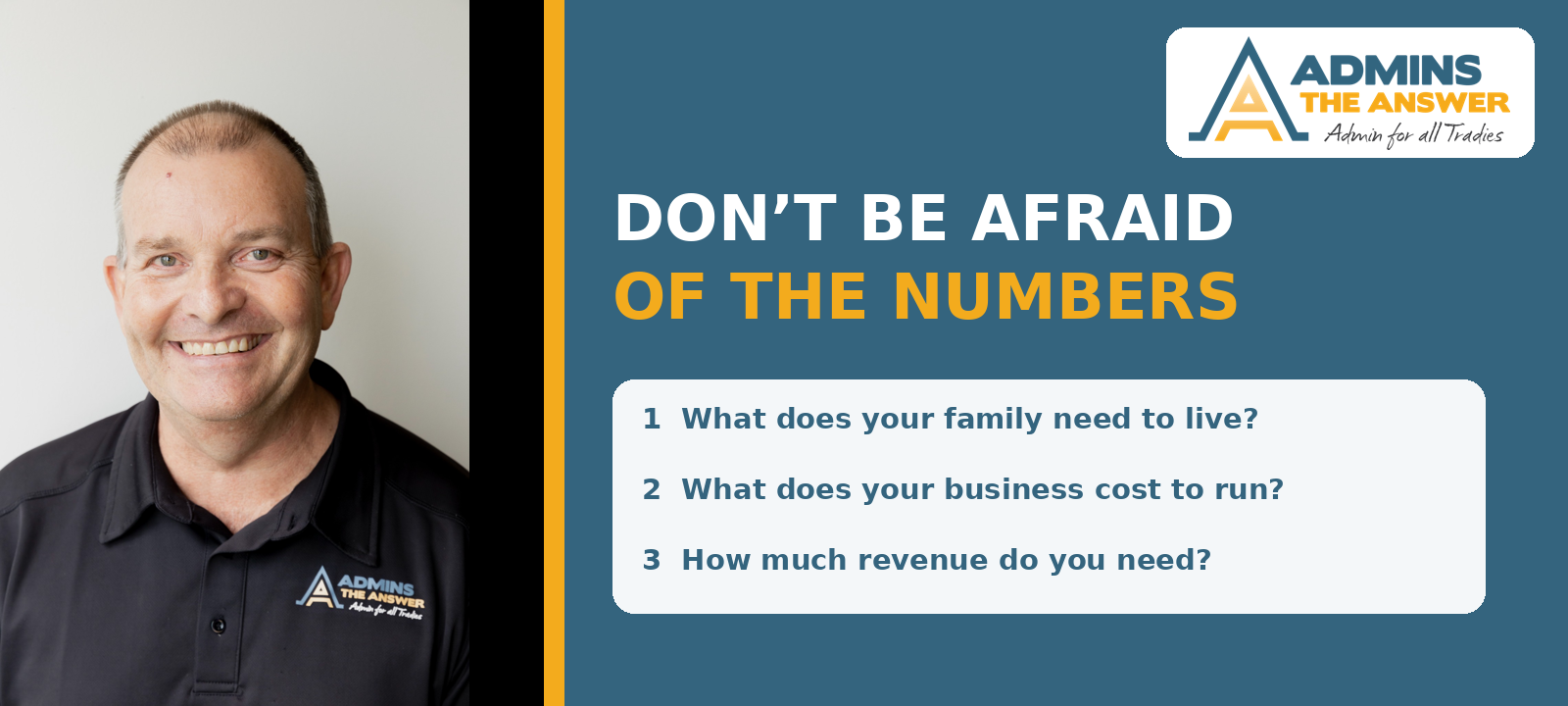
So, which numbers should you know?
I’ve now been running Admins The Answer for ten years, and during that time I’ve continued refining what I learned.
I’ve come to believe there are three fundamental questions every trade business owner should be able to answer.
And the first one might surprise you.
1. How much does your family need to live?
This is where I like to start.
Not with turnover. Not with sales targets. Not even with what the business costs to run.
How much money do you and your family actually need?
I’m talking about paying the mortgage or rent, putting food on the table, covering the household bills and having enough left over to enjoy life a little.
In my experience, accountants and business coaches don’t always spend much time on this question.
And I reckon that’s a mistake.
Because isn’t that a big part of why we get up and go to work every day?
Seriously, what’s the point of working if what you’re doing isn’t enough?
You might have a business turning over hundreds of thousands of dollars, but if it isn’t providing what you and your family need, something has to change.
So start there.
Work out what you genuinely need to take home.
Not what you hope might be left at the end of the month.
What you actually need.
2. What does your business cost to run?
Now we turn our attention to the business itself.
What does it cost you to keep the doors open?
I’m talking about your overheads.
Vehicles, insurance, registrations, software, phones, office expenses, administration and all the other costs that keep ticking away whether you’re busy or not.
And don’t forget the less frequent bills.
Some expenses only arrive quarterly or annually, but that doesn’t mean you can ignore them until they’re due.
I learned firsthand what happens when a bill arrives and the money hasn’t been set aside.
Here’s what I’d suggest: Get those overheads into a spreadsheet or a system you understand. Work out what they cost you over a full year, then break that down into a monthly or weekly figure.
You need to know what the business costs before you’ve even started paying for the materials and labour involved in doing the jobs.
3. How much revenue does your business need to generate?
Now we’re getting somewhere.
You’ve worked out what your family needs.
You understand what your business costs to run.
The next question is how much revenue you need to generate to cover it all.
And here’s where you’ve got to be careful.
If you invoice a customer $10,000, that doesn’t mean you’ve made $10,000.
You’ve still got the costs of doing the work to consider. Materials, labour, subcontractors and whatever else went into completing the job.
So you need to understand how much of your revenue is actually available to cover your overheads and provide the income you need.
That means knowing your job costs and having a reasonable understanding of your margins.
And remember, GST you collect isn’t money you get to keep.
Once you understand these things, you can start working out what your business really needs to earn.
Not just a number that sounds impressive.
A number that actually makes sense for you.
You don’t have to work it all out on your own
Now, I know what some of you might be thinking.
“That’s all very well, Greg, but I’m a tradie, not an accountant.”
Fair enough, too.
I’m not suggesting you need to become a financial expert overnight.
But I do think you need to understand the fundamentals of your own business.
And if you’re not sure where to start, get some advice.
Talk to your accountant or bookkeeper. Find somebody who can help you understand what the figures mean, not just prepare the reports.
And make sure you’ve got systems in place that capture the information properly.
Because if your job costs aren’t recorded, your invoices are going out late and your administration is all over the place, it’s going to be pretty difficult to get an accurate picture of what’s happening.
That’s where having the right people and systems around you can make an enormous difference.
Getting off the hamster wheel
I don’t believe there’s one magic answer to running a successful trade business.
But I do know this.
For me, things started changing when I stopped relying on how busy I was as a measure of how well the business was going.
I started looking at the numbers instead.
And the more I understood them, the better equipped I was to make decisions.
That’s something I’ve carried with me into Admins The Answer.
Because ultimately, I don’t think trade business owners get up every morning just to see how many jobs they can squeeze into the calendar.
They’re working to build a decent business, provide for their families and hopefully have some time to enjoy the rewards of all that hard work.
And if the business isn’t helping you achieve those things, isn’t it worth finding out why?
You don’t have to fix everything tomorrow.
But you can start by understanding those three numbers.
And if you’re stuck on the hamster wheel, perhaps it’s time to get off it long enough to ask for some help.
Related reading: 7 Things Nobody Tells You About Running a Trade Business
Come and have a chat — The ATA Open House
Maybe you’re struggling to understand your business numbers. Maybe your administration is getting away from you, or you’re wondering whether your job management systems are actually helping.
Whatever it is, you’re welcome to come along to The ATA Open House and have a chat with me.
I won’t pretend to have every answer, but I’ve been through plenty of these challenges myself, and hopefully I can help point you in the right direction.
No pressure. No big sales pitch.
Book your place at The ATA Open House
Alternatively, feel free to get in touch with us directly at Admins The Answer.
I’d be happy to have a chat.
Greg
Admins The Answer — Admin for all Tradies

