
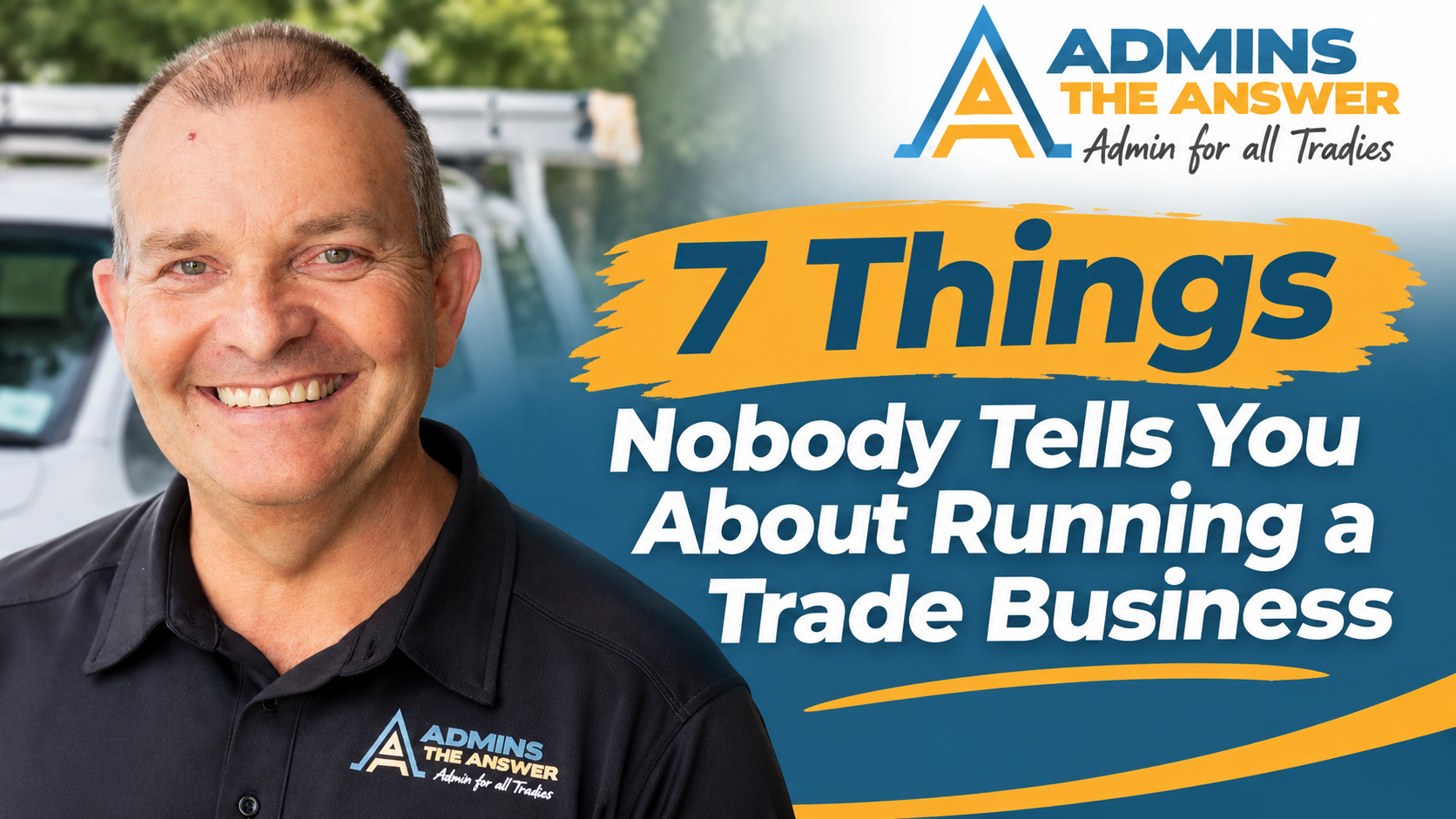
A word from Greg — I’ve been in your boots.
I’ve owned and run a trade business, so I understand firsthand the challenges that come with it. From juggling jobs and customers to managing paperwork, cash flow and everything in between, I know there’s a lot more to running a trade business than being good at your trade.
That’s why I started Admins The Answer — to help tradies spend less time buried in admin and more time doing what they do best.
There’s a lot more to running a trade business than you might expect
When you decide to go out on your own, you’ve probably got a pretty good idea of what you’re getting into.
You know your trade. You know how to do a good job. And you reckon that if you work hard, look after your customers and charge a fair price, you’ll build yourself a decent business.
Sounds reasonable, doesn’t it?
The trouble is, nobody really prepares you for everything else that comes with running a business.
I owned and operated a trade business for seven years, and I can tell you there’s a big difference between being good at your trade and being good at running a trade business.
I don’t regret owning my business. Far from it. But there are certainly things about the way I ran it that I would do differently.
Here are seven things I reckon every tradie should understand about running their own business.
1. Being good at your trade doesn’t automatically make you good at business
You can be a fantastic electrician, plumber, carpenter or handyman and still struggle to make your business work.
Why?
Because running a business requires a whole different set of skills.
Suddenly, you’re not just the person doing the work. You’re also responsible for quoting, invoicing, scheduling, managing customers, keeping an eye on the money and making sure there’s enough work coming in.
And if you’ve got employees, there’s another whole set of responsibilities.
Most tradies have spent years learning their trade, but how much training have they had in actually running a business?
Not much, in many cases.
My advice: Don’t expect yourself to know everything. Recognise where your knowledge is lacking and get help from people who understand those areas.
There’s no shame in asking for advice. In fact, I reckon it’s one of the smartest things a business owner can do.
2. Being busy doesn’t necessarily mean you’re making money
This is a big one.
You can have your phone ringing, jobs booked weeks ahead and your team working flat out, but still finish the month wondering where all the money went.
Being busy and being profitable are two very different things.
It’s easy to concentrate on how much work you’re bringing in without paying enough attention to what it actually costs to deliver that work.
Materials, wages, vehicles, insurance, software, equipment and all those other expenses need to be paid.
And don’t forget, you need to pay yourself properly too.
A job that looks good when you send the quote might not look nearly as attractive once you’ve accounted for all the costs.
My advice: Get into the habit of reviewing your job costs, margins and overheads. Understand what you’re actually earning, not just what you’re invoicing.
You don’t need to become an accountant, but you do need to understand your numbers.
3. The paperwork doesn’t disappear when you finish on the tools
Here’s something I remember all too well.
You finish a long day, get home, have something to eat and then realise you’ve still got quotes to prepare, invoices to send, emails to answer and tomorrow’s jobs to organise.
Sound familiar?
One of the biggest surprises about owning a trade business is how much work happens when you’re not actually doing your trade.
And the frustrating part is that much of this work is absolutely necessary.
If you don’t send the quote, you might not win the job.
If you don’t send the invoice, you’re not going to get paid.
And if you don’t keep your jobs organised, tomorrow can become a bit of a nightmare.
The problem isn’t that administration is unimportant. It’s that too many business owners end up doing all of it themselves.
My advice: Start looking at which tasks genuinely require your involvement and which could be handled by someone else.
Even getting a few regular administrative tasks off your plate can make a difference.
4. You’re responsible for a lot more people than you realise
When you’re working for someone else, you generally have a fairly clear set of responsibilities.
When you own the business, things change.
You’ve got customers expecting you to deliver what you’ve promised. Suppliers who need paying. Employees relying on you to provide work and pay their wages.
And then there’s your own family, who might be wondering when they’re actually going to see you.
That’s a fair bit of responsibility sitting on one person’s shoulders.
And it doesn’t always switch off when you knock off for the day.
One thing I came to appreciate is that running a business isn’t just about organising jobs. It’s also about managing expectations, communicating properly and making decisions that affect other people.
My advice: Don’t try to carry every responsibility in your head.
Have clear systems for keeping track of commitments, following up important matters and making sure people know what’s happening.
The more organised your business becomes, the less you need to rely on remembering everything yourself.
5. Working longer hours isn’t always the answer
When things get busy or something isn’t working properly, what’s the natural response?
Work a bit harder. Start earlier. Finish later. Catch up over the weekend.
I understand that thinking because I’ve been there.
And sometimes, yes, you’ve simply got to put in the extra effort.
But if working longer hours becomes your permanent solution, I’d suggest there’s something else that needs attention.
Maybe your quoting process is taking too long. Maybe your scheduling is disorganised. Maybe you’re doing jobs that someone else could handle.
Or perhaps you’ve simply taken on more work than your current systems can comfortably manage.
My advice: When you find yourself constantly working late, ask why.
Don’t just look at how you can get through the workload. Look at what’s creating it in the first place.
Sometimes the best improvement you can make isn’t working harder. It’s changing the way the work gets done.
6. You can’t do everything yourself forever
When you first start out, doing everything yourself might make sense.
You’re watching every dollar, learning how the business operates and trying to establish yourself.
But as the business grows, that approach can become a problem.
The trouble is, handing over responsibility isn’t always easy.
You might think it’s quicker to do something yourself than explain it to someone else.
And sometimes it probably is — the first time.
But what about the next 50 times?
If you’re the only person who knows how everything works, you’re going to have a hard time getting away from the business.
My advice: Start documenting the way you do things and gradually hand over responsibilities that don’t need your personal attention.
Give people clear instructions, the right tools and enough support to do the job properly.
Delegating doesn’t mean losing control of your business. Done properly, it can give you more control because you’re no longer trying to manage every little detail yourself.
7. Success doesn’t have to mean building a bigger business
I reckon this is something we don’t talk about nearly enough.
There’s a lot of emphasis on growing your business.
More employees. More vehicles. More jobs. More turnover.
And there’s nothing wrong with that if it’s what you want.
But bigger doesn’t automatically mean better.
A business with ten employees isn’t necessarily more successful than one with two.
It depends on what the owner wants to achieve.
For some people, success means building a large operation. For others, it might mean earning a good income, having a reliable team and being able to finish work at a reasonable hour.
Neither is right or wrong.
What matters is whether the business is delivering the life you actually want.
My advice: Take some time to think about what success means to you.
How much money do you want to earn? How many hours do you want to work? What responsibilities do you enjoy, and which ones would you rather hand over?
Once you’ve worked that out, you can start making decisions that move your business in the right direction.
Rather than simply chasing growth because you think that’s what successful business owners are supposed to do.
So, what’s the takeaway?
If there’s one thing I’ve learned from owning a trade business, it’s that working hard and being good at your trade are only part of the equation.
You also need to understand your numbers, manage your time, look after your customers and employees, and put systems in place that make the business easier to run.
And you don’t have to become an expert at everything.
One of the smartest things you can do is recognise what you’re good at, identify where you need help and build the right support around you.
Because ultimately, your business should be working for you — not the other way around.
Let’s have a chat
If any of these seven points sound familiar, I’d be happy to have a chat.
At Admins The Answer, we help Australian trade business owners get their administration organised, improve their systems and take some of the pressure off their shoulders.
You’re welcome to contact Admins The Answer directly if you’d like to talk through what’s happening in your business.
Or come along to The ATA Open House. It’s an opportunity to speak with me directly, ask questions and have a chat about the challenges you’re facing in your trade business.
Book your place at The ATA Open House
I’d love to hear how you’re going.
Greg Smith
Admins The Answer — Admin for all Tradies

